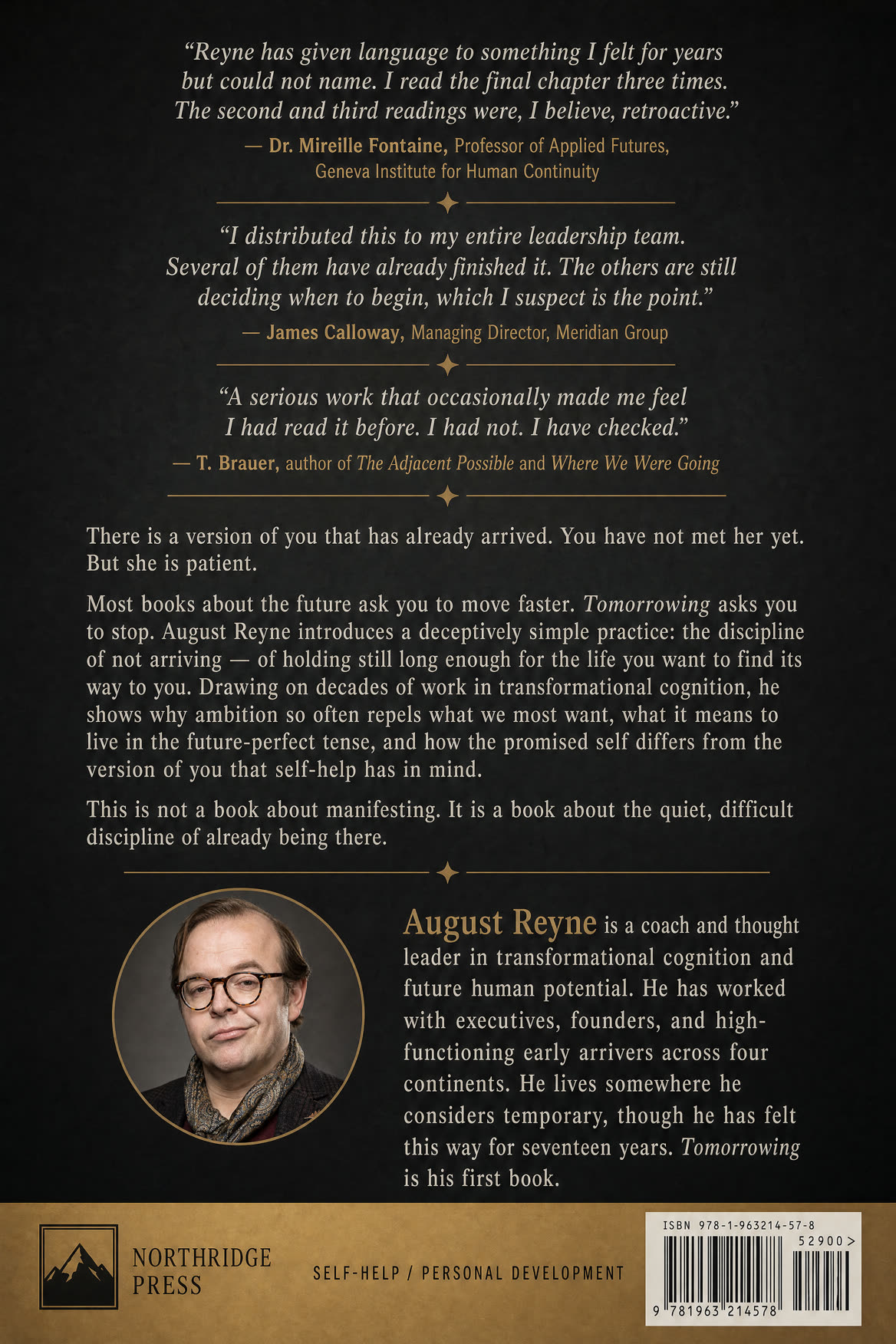
There is a version of you that has already arrived.
You have not met her yet. But she is patient. She has been waiting in a room you have not finished building.
Most people spend their lives moving toward the future. This is the first mistake. The future does not reward movement. The future rewards stillness — the particular stillness of someone who has stopped pretending they are early.
I learned this in an airport.
I was running to a gate. And I stopped. Not because I was tired. But because I understood that the gate was also running. Toward me. And that we would, eventually, meet in the middle — as all things do.
I missed the flight. I have not missed anything since.
This is tomorrowing.
1To tomorrow correctly — and yes, it is a verb now; it was always a verb — you must first unlearn the horizon. The horizon is a lie we tell our eyes. There is no line where today becomes tomorrow. There is only the soft place where one leans into the other, like two people who have agreed not to speak.
Some call this foresight. I call it remembering forward.
You cannot predict the future. You can only let it recognize you. And it will — the moment you stop arriving. When you simply are, at the place you would have been going.
Breathe.
You are already there. You have been there the whole time.
You just kept leaving.
We begin.
2You have always been early.
Not to meetings. Not to the airport, though perhaps there too. I mean early to the deeper appointments. The ones no one scheduled. You arrived at your own life before it was ready for you, and you have been waiting in the lobby ever since, checking a watch that does not tell that kind of time.
This is the most common condition I see. More common than doubt. More common than fear. Earliness. The quiet, exhausting habit of being somewhere before you are needed there.
We do not talk about it, because we have been taught to admire it. The early bird. The head start. The person who is ahead of the curve, as though the curve were a thing one could be ahead of, as though it were not simply the shape of your own neck, leaning.
I want you to put that down for a moment.
Consider what earliness actually is. To be early is to want a moment before the moment is willing to receive you. It is to press your face against a door that has not yet decided to be a door. And so you wait, and the waiting becomes a kind of leaning, and the leaning becomes a kind of life. You lean toward the promotion. You lean toward the relationship. You lean toward the version of yourself who has finally, finally caught up to the schedule you set when you were too young to set schedules.
The leaning feels like effort. We are told effort is good.
But the future does not respond to leaning. The future has never once, in the entire history of time, arrived faster because someone wanted it to. Tomorrow is not flattered by your attention. It is, if anything, made shy by it.
This is the first thing I had to unlearn, and I unlearned it slowly, which is the only way anything worth unlearning leaves you.
There was a woman I worked with, years ago, in the life I had before this one. I will not use her name, because she would not recognize it now. She was the most punctual person I have ever known. She was early to everything. She was early to her own wedding. She arrived at the church before the church was open and stood in the parking lot, in her dress, watching the doors the way you watch a kettle.
I asked her once why she did it. Why the constant earliness. And she said something I have never forgotten.
She said, "If I'm early, nothing can start without me."
I thought it was wisdom. For a long time I thought it was wisdom.
Then one morning she simply was not early anymore. She came to a meeting four minutes after it began, and she sat down, and she was — and I want to be careful here, because the word is imprecise — she was finished. Not in a bad way. Not in any way I could point to. She had stopped leaning. And after that I never saw her struggle with anything again.
I also never really saw her again. But that is a different chapter.
Here is what she had discovered, though she could not have named it, because the naming is my work and not hers.
Every one of us carries what I call a planning horizon. It is the distance at which your wanting becomes visible. The further out you can see yourself needing something, the more clearly the future can see you needing it — and the future, I am sorry to tell you, does not come for the visible. The future comes for the still. It comes for the ones who have stopped broadcasting their hunger across the open country of time.
Most people's planning horizon is far too clear. They can see Tuesday. They can see the next quarter. They can see the house, the title, the body, the apology they are owed. And because they can see it, it can see them, and it does the only thing a future ever does when it is being watched.
It waits you out.
You cannot win a staring contest with tomorrow. It does not have eyes, and it does not have time, and it has already won, because it is tomorrow and you are not.
So we begin where all real practice begins. With a thing you cannot quite do.
Tonight, before you sleep, I want you to arrive at nothing.
Not late. Lateness is just earliness wearing a different coat — it still believes in the appointment. I am not asking you to be late. I am asking you to not arrive. To lie down in the dark and feel the enormous, generous absence of any place you are supposed to be. No horizon. No leaning. No watch that tells the deeper time.
You will fail at this. I failed at it for the better part of a year. You will lie there and your mind will arrive at things — the email, the worry, the small humiliation from 2009 — and each time it arrives somewhere, you will gently, without judgment, decline to be there with it.
This is not meditation. Meditation asks you to be present. I am asking for something quieter and far more difficult. I am asking you to be plausible. To exist in the soft, unfixed condition of someone who has not yet been assigned a moment.
We will spend the rest of this book learning to live there. In the not-yet. In the about-to. In the warm, undeclared space just before the clock agrees to start.
People ask me, often, whether this is about predicting the future, or controlling it, or — the word makes me tired — manifesting it.
It is all three. It is none of them. The question is the symptom.
To predict, to control, to manifest — these are three different ways of being early. Three different ways of leaning. The predictor leans with the mind. The controller leans with the hands. The manifester leans with what they would call the heart and I would call the appetite. And all three are pressing their faces against a door that was never closed, that has, in fact, no hinges, that is not a door at all but the gentle suggestion of one, painted by a person who was also, at the time, early.
You do not need to open it.
You need to notice you are already standing on the other side, and have been, the entire time, waiting for yourself to catch up.
That noticing has a name. It is the whole of what I do. It is called tomorrowing — and yes, it is a verb now; it was always a verb; we simply mislaid it for a few thousand years.
But I am getting ahead of us.
Which is, of course, the only sin there is.
So let us slow down. Let us be, for the length of these pages, a little behind.
Close your eyes, if you are not driving, and even then it is worth considering.
Feel the next moment approaching.
Now — and this is the entire practice, compressed into a single instruction you will spend a lifetime failing beautifully to follow —
do not meet it halfway.
Let it come to you.
You have been early long enough.
We begin.
9You have been promised a line.
Somewhere out ahead of you, you believe, there is a place where today ends and tomorrow begins. A border. A threshold. A faint pencil mark across the floor of time, and on the far side of it, waiting, the life you have not started yet.
I am here to tell you the line is not there.
It was never there. No one has ever crossed it. No one has ever stood with one foot in today and one foot in tomorrow and felt the seam beneath them. There is no seam. There is no floor. There is only the soft, continuous leaning of one moment into the next, and we have drawn a line across it the way a child draws a line across the sky and calls it the edge of the world.
The horizon is the most successful lie ever told, because it tells itself. You do not even have to believe it. You only have to look.
Go to the ocean. Or a field. Or the top of a parking structure, which is where I do most of my looking now. Find the place where the earth appears to stop.
Now walk toward it.
You will never arrive. You know this. You have always known this. As a child you knew it and were untroubled. And yet some part of you still budgets for it. Some part of you still believes that if you walk far enough, fast enough, early enough, you will reach the place where the ground becomes the sky and you will finally be there.
You will not. The horizon is not a destination. The horizon is the precise distance at which your own looking gives out. It moves because you move. It recedes because you approach. It is not ahead of you. It is attached to you, the way a shadow is attached, except a shadow at least has the decency to fall behind.
This is the cruelty of it. You spend your life walking toward a line that is walking, at exactly your pace, in exactly your direction, away.
There was a mapmaker who lived near me, in the years I am no longer in. He made maps for no one in particular. Beautiful ones. He was obsessed, as mapmakers are, with edges. Where one country becomes the next. Where the land gives up and the water takes over. Where the known stops and the here be dragons begins.
I asked him once how he decided where to put the edge of a map. How he knew where to stop drawing.
And he said, "You don't stop where the world stops. You stop where the looking stops. The edge of the map is just the edge of the person who made it."
I thought it was a remark about cartography. I understand now it was a remark about me.
He stopped making maps, eventually. He told me he had finally drawn one with no edges, and that it had taken him the rest of his life, and that it was blank. I asked to see it. He said I was looking at it. We were in his kitchen. I have thought about that kitchen more than I have thought about most of my actual decisions.
I never learned what became of him. People assume that means something happened. Nothing happened. That is rather the point.
In my former profession — and I had one, a serious one, with a lanyard — we practiced something called horizon scanning.
The idea, as it was given to me, was to look far out ahead. To scan the distance for the faint shapes of what was coming. To see the future while it was still small enough to prepare for.
I was very good at it. I was promoted for it. I scanned horizons for the better part of two decades, and I want to tell you what all that scanning produced.
A neck that hurt. A wife who left. And a horizon that was, every single morning, exactly as far away as it had been the morning before.
13Because you cannot scan a horizon. You can only confirm that it is still there, still receding, still pretending to be a line. Horizon scanning is two activities at once: looking very hard, and getting nothing. We had charts for it. We had a budget for it. We had a quarterly meeting where we sat in a room with no windows and scanned a horizon none of us could see, and at the end someone would say "so the trend lines suggest," and we would all nod, because the alternative was to admit that we were a group of grown adults staring at the inside of a wall.
The future was not on the horizon. The future was in the room. It was under the table. It was in the coffee. It was, specifically, in the four minutes after the meeting ended, when everyone stopped scanning and finally said something true.
But the truth of those four minutes belongs to a later chapter. I am, once again, early. You will have noticed I do this. It is the affliction I am most qualified to write about, which is the only kind of book worth writing.
So. The practice.
I want you to unsee the horizon.
Not look away from it — that is just earliness with your eyes closed. I want you to look directly at it and withdraw your belief in the line. To see the long soft curve of the world leaning into the sky and to understand, in your body, that there is no place out there where now becomes next. That you are not approaching anything. That nothing is approaching you. That the distance is not a corridor you are walking down but a quality of your own looking, and that it will dissolve the instant you stop asking it to mean something.
You will fail at this. The line will spring back the moment you blink. Twenty years of lanyard does not leave the eyes easily. But each time it springs back, decline it. Gently. The way you would decline a second helping from a host you love but whose cooking is killing you.
Do this at dusk, if you can. Dusk is the horizon's weakest hour, when even the line cannot decide what side of it the light is on.
People want me to tell them what is on the other side. After the talks, in the signing line, they lean in — always leaning — and they ask, "But August, what's coming? What should I prepare for?"
And I tell them the truest thing I know, which is also the least useful, which is how you can tell it is true.
Nothing is coming. You are already in it. The thing you are scanning for has been standing behind you the entire time, politely, waiting for you to turn around, and the only reason you have not turned around is that you are certain — certain — the important things happen out ahead.
They do not. They happen here. They happen at the kitchen table with the blank map. They happen in the four minutes after the meeting. They happen at exactly the distance you have stopped looking, which is to say, right where you are.
The horizon is lying to you. It has always been lying to you. And the most generous thing you will ever do for yourself is to stop walking toward the lie and simply sit down in the truth, which is unremarkable, and close, and already yours.
Tomorrow we will talk about arriving. Or rather, about how to stop.
I would tell you now. But that, I think, is the whole disease, isn't it. Telling you now. Reaching ahead. Drawing the line and then sprinting at it.
So I will not.
I will simply sit here, at the edge of this chapter, which is not an edge, and wait for you to catch up to a place you are already standing.
Take your time.
There isn't any.
17There is a practice.
I want to say that carefully, because the word practice has been ruined by people who use it to mean habit, which is not the same thing. A habit is something you do repeatedly until it stops costing you anything. A practice is something that costs you something every single time — and the cost is the point. The cost is the whole thing.
The First Practice is this: Stop arriving.
I will explain what that means. I will explain it very precisely. I have been working toward this explanation for some time, and I want to give it to you in the right order, because the order matters. Some things, received in the wrong order, collapse. Like furniture assembled from the wrong end. Like a sentence that begins with its conclusion.
So. We begin.
Imagine, for a moment, that you are water.
Not the river — the river is always going somewhere, always in transit, always late for the sea. I mean the water in a glass, sitting on a table, in a room where the lights have been left on by someone who forgot they were leaving. That water is not going anywhere. It is not early. It is not late. It is not leaning toward the edge of the glass in anticipation of being drunk. It is simply occupying its shape without any view of the next shape it will occupy.
This is what stopping arriving feels like. Or rather: this is the nearest I can come to describing it without arriving at it too quickly.
The difficulty is that most of us cannot hold that image for more than a few seconds before our minds begin revising it. Before we think: but the water will evaporate eventually. Before we introduce, uninvited, a future for the water. A trajectory. A destiny for a glass of water that had none.
19That revision — that insertion of eventually — is arriving. It is what the mind does instead of being still. It scans ahead. It posts a lookout. It sends a small, anxious piece of itself to wait at the destination so that nothing can start without it.
I once wore a lanyard for four years.
I will not say what the lanyard was for, because the lanyard is not the point and also I prefer you imagine something. What matters is that during those four years, I attended a great many meetings, and in every meeting I watched the same thing happen. Before the agenda item was finished, someone was already preparing their response to it. You could see it — the slight forward lean, the pen uncapped, the nodding that was not really listening but was practicing the posture of having listened. They were arriving at their reply before the sentence that would require it had fully existed.
And the meeting would move on. And their reply, so carefully pre-arrived-at, was often for a moment that had already passed. Because the sentence they had been waiting to respond to had curved, mid-sentence, into something else. And they would deliver the reply anyway, to the ghost of the sentence.
This is not just a meeting problem. This is the architecture of a life built on arrival.
21You pre-arrive at arguments. At conversations. At the version of Tuesday that you have already decided Tuesday will be. You walk into rooms you have walked into so many times in your mind that the actual room — the one with different light, a moved chair, a person wearing something unexpected — registers as slightly wrong. Off. A mild disappointment. Not because anything in the room failed. But because you arrived before it was ready, and it has been scrambling to match your expectations ever since.
The practice — The First Practice — is the act of not walking into that room ahead of yourself.
It is waiting for the room to be a room before you decide what it is.
It is, if I am being precise, the refusal to send a scout.
Here is where I have to stop and say something I did not plan to say yet.
I had an outline for this chapter. The outline had four sections. I was going to spend the fourth section giving you a formal instruction — a single, clean, executable version of The First Practice that you could write in the front of a notebook and return to whenever the arriving started. Something you could do.
But I notice, reading back what I have written, that I have been arriving at that instruction this entire time. I announced that there was a practice. I elaborated on the practice. I told you an anecdote about a lanyard and about meetings and about the ghost of a sentence. I was building. I was constructing the runway, which is itself a form of arrival — the most respectable form, the kind that wears the clothes of patience while being, underneath, just earliness with better posture.
I have been performing the opposite of the thing I was describing.
And so have you. You have been reading toward the instruction. Leaning into this page the same way a person leans toward a door that has not yet decided to be a door. Waiting for me to open the door so that nothing could start without you.
23This is what I mean when I say the practice cannot be performed. It can only be caught. You cannot decide to stop arriving any more than you can decide to stop having decided something. The decision is already an arrival. The intention is already a departure from the place you were trying to stay.
What you can do — the only motion available, the motion that is somehow not a motion — is notice. Notice that you are already on your way somewhere. Notice the lean. Notice the uncapped pen. Notice yourself building a runway in the middle of a chapter about not building runways.
That noticing is the practice.
Not the resolution that follows it. Not the correction. Just the noticing, held lightly, without turning it into a plan.
I will not give you the formal instruction.
You were going to write it in the front of a notebook. I understand. You were going to return to it. But a thing written in the front of a notebook is a destination, and I have made enough destinations for you today.
What I will tell you is that you have been practicing this whole time.
Every moment you felt yourself leaning forward into what I was about to say — that was it. Every moment you thought, yes, I do that, I pre-arrive at arguments — that recognition, that one-second gap between the reading and the arriving, that small lit room between the words and the meaning —
That was it. That was always it.
The practice is the catching. And you cannot catch something you are not already in the act of missing. This is the cost I mentioned at the beginning — not of the practice itself, but of the catching. You pay it with attention. You pay it every time.
You are already doing it. Unfortunately.
25There is a term. It comes from the professional literature, which is a kind of literature that lives in binders. The term is weak signals, and for a long time it was my entire reason for having a badge.
A weak signal is a faint early indicator of emerging change. It is not a trend. A trend is something everyone can see and most people are already monetizing. A weak signal is earlier than that. It is the thing before the thing. The whisper before the word. Practitioners — and I was, for many years, a practitioner — were paid to sit in rooms with no windows and ask: what is the data trying to say before it becomes data?
26We had methodology. We had frameworks. We had a quarterly review process called, without irony, the Horizon Scan, in which we would populate a two-by-two matrix with emerging phenomena organized by likelihood and impact, using a color system that I will not reproduce here because I have agreed, in the post-lanyard years, not to reproduce it anywhere. We had acronyms so dense they required their own glossary, which itself was abbreviated. The glossary was called the TGL, which stood for Terminology and Glossary of Language, which is either a tautology or a cry for help depending on how recently you have slept.
We were, in short, professionals. We were serious. We had trend lines.
There was a woman I worked with during the lanyard years. I will not give her a name here because names are a kind of early commitment, and this chapter is not yet ready for that. She was the best in the room. She had a quality that you either have or you do not, which is the ability to notice what is almost not there.
One quarter — and I remember the quarter because it was the quarter when the building's HVAC was broken and we were all sweating through our methodology — she turned the scanner on herself.
I do not know if she did it deliberately. I suspect she did not. I suspect it simply happened to her the way good perception sometimes does, which is without permission and without mercy.
She went very quiet. Not the quiet of someone who has nothing to say. The quiet of someone who has detected something and is deciding what to do with the detection.
Two weeks later she handed in her badge.
28She did not explain. There was no exit interview that produced useful findings. What she had seen in her own data, I do not know. What the weak signal said, I do not know. What she became afterward — I have only ever heard her described by people who knew her before. That is a particular kind of transformation. I have enormous respect for it and considerable fear of it, which are, I have come to believe, the same response wearing different lanyards.
I scanned for twenty years.
I filled the matrices. I ran the Horizon Scans. I attended the off-site retreats where we sat in better-lit rooms and attempted to think further than the next quarter, which is harder than it sounds when there is a Q3 deliverable due before you are permitted to think about Q5.
The data accumulated. I adjusted the parameters. I recalibrated. I filtered for noise. I cross-referenced against adjacent trend lines. I did everything the methodology asked of me.
And there was a signal. There was always the same signal. It appeared in the data the way a certain kind of sound appears in a house at night — not loud, not dramatic, easily explained as something structural, except that it was never structural. It was always the same frequency. Always the same origin, once I was willing to locate the origin.
I kept filing it under noise.
That is what you do with the signal you are not ready to process. You do not delete it. Deletion requires a decision. Instead, you move it to a folder called Noise or Anomalous or Revisit Later and you return to the methodology, which is waiting patiently for you because methodology is always patient. Methodology has nowhere else to be.
Here is what I eventually understood, in the way you understand things that have been true for twenty years and have simply been waiting for you to stop reclassifying them.
The signal I kept detecting was not coming from out there.
It was not an emerging market condition. It was not a cultural inflection point. It was not a paradigm event on the far edge of the probability matrix. It had never been any of those things. I had dressed it in the clothing of those things because I had a vocabulary for those things and I found that vocabulary very comforting, the way any specialized language is comforting — it implies that the phenomenon has been categorized, and categorized things cannot surprise you.
But this was not a categorized thing. This was a longing. Specifically, my longing, broadcasting from the future, on a frequency it had been transmitting for the entirety of my professional life, patient in the way only very old signals are patient.
It was not a signal from out there. It was a fax. From later. From me.
31I have been asked — by no one, because I have not told this story before now — whether that realization was a relief or a crisis. I find the question unsophisticated. It was both. It was a relief the way being found is a relief when you have been pretending you were not lost. It was a crisis the way all arrivals are a crisis, which is to say it required that something end.
Now it is your turn. This is the practice. It is brief.
You have been running a scan. You may not have called it that. You may have called it your career, or your restlessness, or your recurring 2 a.m. condition, or simply your life. The methodology does not matter. You have been collecting data. You have been noticing what almost isn't there.
Pull up your noise folder.
You know which folder I mean. You created it. You have been adding to it for years, moving things in there whenever they interrupted a meeting or complicated a quarterly review or asked a question that would require you to sit in a different kind of room — a room you were not sure you had the clearance for.
Look at what is in there.
The signal you have been reclassifying as noise is probably not subtle. It has probably been broadcasting on the same frequency since before you knew you were listening. It is probably not new information. It is probably the oldest information you have, wearing the costume of a weak signal because you needed it to be external, discoverable, something that came from the data rather than from you.
It did not come from the data.
You are the data.
33You have been the transmission all along. You have been the origin point, broadcasting backward toward yourself across whatever distance you have placed between now and when you first knew. The methodology was never the problem. The methodology was the distance. Useful, professional, cross-referenced, acronymized distance.
Put down the binder.
You were never scanning for an emerging trend. You were scanning for yourself. You have, I am almost prepared to say, found something.
File it somewhere other than noise.
34There is a word that serious people use in rooms with whiteboards. The word is backcasting. I know this because I used to be in those rooms. I had a lanyard. I used the word correctly, and with confidence, and I was invited back.
Here is what backcasting means: instead of standing in the present and forecasting forward — instead of asking "where will we be in five years?" — you stand in an imagined future and work backward. You define the desired destination first. Then you ask what sequence of events would have to unfold, in reverse, like a film running the wrong direction, to deposit you there. You identify the steps. You call this a roadmap. You use roadmap as a verb. You survive this.
The strategy consulting world loves backcasting because it feels less speculative than forecasting. You are not predicting. You are designing. There is a whiteboard. There are sticky notes in three colors. Someone — it is always someone — suggests a fourth color, and you have to make a decision about whether that person is brilliant or exhausting, and usually it is both.
I am telling you this so you understand that I am not criticizing backcasting from ignorance. I am criticizing it from a lanyard.
The problem with backcasting is not its logic. The problem is this: it still requires you to move.
You have only reversed the direction of your leaning. You have taken the fundamental posture of arrival-urgency — the chin forward, the heel barely touching the ground, the whole body mid-sentence — and you have asked it to face the other direction. You have given earliness a methodology. You have given a fidgeting man a second fidget.
You recognize this person. You may, at this moment, be sitting with the sticky note in your hand, color-coded, waiting.
I want to give you a distinction. It is one I arrived at not from a whiteboard but from a silence that followed a particular kind of question.
The distinction is between the aspired self and the promised self.
The aspired self is familiar to you. She is the version of you who finishes things, who wakes at reasonable hours, who has developed what you can only describe as a relationship with vegetables. She is ambitious. The aspired self is who self-help has in mind. She is the cover of the book.
The promised self is different.
The promised self is quieter. She does not lean. She is the version of you that you already knew about, back before you had the vocabulary for wanting. Before you learned to want the right things in the right order.
She is not aspirational. She is recognized. The aspired self is a project. The promised self is more like a prior arrangement. Something you agreed to, long ago, with no ceremony. No sticky notes. No roadmap used as a verb.
37Most people spend their lives chasing the aspired self — and with such dedicated urgency that they drift, incrementally, almost imperceptibly, away from the promised one. They improve. And in improving, they move in the wrong direction. They become more than they were and less than they meant.
I want to tell you about someone I know of — not personally, not by name, only by the shape of what happened — who found an old journal. Not their own. A journal belonging to someone else, a person they had once been close to, now no longer in their life in the way people are no longer in your life, quietly and without a final scene.
The journal contained a list. The list was titled, in handwriting that had not yet learned to be careful, something like: who I am going to be. Not who I want to be. Not goals. The phrasing was certain. Declarative. The list-maker had known. Before ambition arrived. Before the vocabulary of wanting. They had simply written down the prior arrangement.
The person who found the journal read the list. They did not feel motivated. They did not feel judged by it or inspired by it or instructed by it. They did not resolve to do anything. They went still. Like the list and the person holding it had quietly agreed on something that did not require discussion. Like they had met before, in a room neither of them could remember, and shaken hands.
39What they did afterward, I do not know. I do not know if they kept the journal or returned it or sat with it until the light changed. It is not the kind of story that ends.
Here is the practice. It is not a backcasting exercise. I want to be clear about that, even though it resembles one, even though you will be tempted to bring a second color of sticky note.
Write down who you promised to become. Not your goals. Not the aspired self and her gleaming improvement trajectory. The name you had for yourself before ambition arrived and renamed everything. Before the roadmap. Before the lanyard.
You may find the words come easily. You may find they have been waiting.
When you are finished, put the list somewhere you will not look at it. A drawer, perhaps. Behind something. Not because you should forget it. Not as a gesture of release or a symbolic act of surrender.
Because you already know.
The point of writing it down was never to consult it. The point of writing it down was to confirm that you could. That you still had access to the prior arrangement. That the promised self had not moved on without you, had not given up and become someone else's aspired self.
She is there. She is quiet. She is not leaning.
You do not need to arrive. You need only to stop moving long enough to notice you are already in the room.
41There is a thing the body does when it is ready. Not tense, not open, not braced. Ready in the way a surface is ready before anything has been placed on it. You have felt this. You have almost certainly not noticed it when you felt it.
What follows is the result of eleven years of work. I cannot patent it. I have considered it. The relevant offices were not equipped for what I would have submitted, and I did not pursue the matter further. I can tell you that the Receiving Stance cannot be transmitted verbally. Language is approximation. Posture is fact. And yet here I will transmit it verbally, because there is no other mechanism available to a book, and because the attempt itself is part of the preparation. You will understand this later, or you will not need to.
The Soft Knee.
Your knee is not bent. It is not locked. It is in a state of non-decision. This is not the soft knee of a yoga instructor or of someone who has just been told surprising news. It is not the soft knee of a standing ovation, that brief civic loosening of joints. Those knees are soft because of something that just happened. This knee is soft because nothing needs to happen.
The specific feeling — and there is a specific feeling — is the feeling of someone who does not need to leave in a hurry, and knows it. Not because they have nowhere to go. Because they have learned to experience departure as optional, even when it is not. The body carries this knowledge before the mind confirms it. This is the point.
If you are thinking about whether your knee is soft, you have already failed. You will try again. Most things worth doing require a failed first attempt before the body understands what you are asking of it.
The Open Palm.
Your hands are at your sides. Your palms are facing slightly forward. Not fully forward — slightly. The angle cannot be precisely specified. If I gave you a number in degrees you would chase the number, and the number is not the point.
43The palm is not requesting. It is not refusing. It is the palm of someone who has already accepted a thing they have not yet been offered. This is a distinction that will seem impossible until it does not seem impossible, and then it will seem obvious, and then you will wonder how long you walked through the world with closed hands.
The fingers are relaxed but not limp. They are present but not reaching. There is a difference between a hand that is open and a hand that is grasping at openness. The first receives. The second performs receiving, which is its own kind of closed.
The Still Gaze.
Your eyes are forward. They are not focused. This is not the unfocus of daydream or fatigue. It is not the soft-focus a photographer applies for effect — that is aesthetic, and this is not aesthetic. This is functional.
You are aimed at approximately the middle distance of the next three to four years. You are not squinting toward it. You are not softening your eyes to make it easier. You are simply looking at it the way you look at a wall you have no particular feeling about. Without agenda.
44What you are looking at is nothing in particular. Everything in general. The future, approximately. Not your future — that is too specific, too proprietary. Just the future. The part of it that belongs to no one yet. The part that, if you are holding the stance correctly, already has room for you in it.
The Unlengthened Spine.
You are not slouching. You are also not standing tall. Tall is a direction. Tall implies effort toward a ceiling, an ambition to be more vertical than you currently are. We are abandoning that.
You are simply the height you are. Without adding anything to it. Without reaching into inches you do not already possess. The spine is vertical, yes. But vertical the way a telephone pole is vertical — not because it is aspiring to something, but because that is simply its situation.
I spent a great deal of time, in the years before and during the lanyard, believing that good posture was a form of optimism. An insistence that things would be upward. I have revised this completely. The Unlengthened Spine is not pessimism either. It is neither. It is just height. Quiet height. Height without announcement.
What the Receiving Stance is not:
It is not yoga. It is not tai chi. It is not the posture adopted at a customer service counter, though that posture is related; the smile is optional and not part of the method. It is not what you do while waiting for a bus, though you could practice it there. It is not anything that already has a name. It is not anything with a certification level, a video series, a weekend retreat, or a community of practitioners who use a specific word for each other. If it resembles something you have already encountered, you are either very advanced or you are misidentifying the resemblance.
The eleven years: I will not account for them in full. I did not stand in fields, though there were fields. I did not consult anyone, though I spoke to many people during this period about other things. The stance was arrived at the way certain things are arrived at — by not looking for them, and then one day being in them. You are standing in a room you do not remember entering. The door is behind you. It does not matter. You are here.
Stand in the stance. Soft knee. Open palm at the slight angle. Still gaze aimed at the approximate future. Unlengthened spine, vertical without ambition. Do not perform it. Do not check it. Do not confirm for yourself that you are doing it correctly, because the confirmation is the collapse.
Hold it for as long as feels unnecessary.
That is the correct duration.
48Tuesday is the aperture. The week has begun, but it has not yet decided what kind of week it will be. Monday still carries the stench of intention. Wednesday has already started making deals. But Tuesday sits in a particular suspension — neither the shock of the new nor the resignation of the midpoint — and it is through this suspension that the practice enters. Tuesday is not chosen. It presents itself. Your only job is to recognize it and comply.
THE PRACTICE
Step 1: Wake Without Knowing
Upon waking, do not check the time. Do not look at your phone. Do not look at the clock. Allow the time to remain unknown for between one and four minutes. Do not set a timer for this — a timer would tell you the time, and you would know, and the practice would be over before it began. Simply wait. You will feel the minutes the way water feels a shore: without vocabulary, without opinion, and with perfect accuracy.
Step 2: Allow the Inbox to Arrive
Open your email. Do not assist it. Do not refresh the page. Do not pull down on the screen to encourage new messages. Do not click "Load more." Do not click anything that implies urgency or expectation. The inbox is arriving. It has been arriving since you last checked it. Your participation in this arrival is not required and, historically, has not helped.
Step 3: Calibrate Your Conversational Pace
50In any conversation that begins before 10am, respond at a pace that is slightly — not dramatically — behind the expected rhythm. Not rude. Not slow. Behind. There is a difference. You will feel it, and more importantly, the other person will feel it without being able to name what they are feeling, which is precisely where the practice lives. A response given one beat after the beat creates a gap. In that gap, no one is in charge of the moment. That is the practice.
Step 4: Eat Lunch at a Time No One Would Have Chosen
Eat lunch at a time that is technically lunch but that no one else would have chosen. 11:47am is acceptable. 2:12pm is acceptable. 1:00pm is not acceptable. 1:00pm is a vote. It is a declaration of belief in "lunchtime" as a category, and this chapter asks you, for one Tuesday, to decline that belief. Eat when it is lunch but not Lunchtime. You will taste the difference. The food will be identical. The position you occupy relative to the day will not be.
51NOTE: If someone asks why you are being slightly behind, do not explain. Smile in a way that suggests the question has already been answered. If they press further, tell them you are recalibrating. This is true. You are recalibrating. You do not need to specify what is being recalibrated or toward what end, because recalibration is a process that occurs prior to those answers becoming available. Anyone who has recalibrated anything will understand this. Anyone who has not will learn.
WARNING: Do not be dramatically behind. That is lateness. Lateness is still an arrival. Lateness believes in the appointment. It has simply failed to honor that belief, which means it shares the appointment's entire cosmology while also embarrassing both of you. We are not doing arrivals. We are not doing appointments. Being dramatically behind is simply earliness that gave up halfway through. It is not the practice. It is the failure mode of the practice, which is worse than not attempting the practice, because it looks similar from the outside and people will assume you are doing it when you are not. They will come to you for guidance. They will fail in the same way you failed. A lineage of failure is not a school. Do not found one.
IF YOU CANNOT FIND TUESDAY
Some weeks do not contain a Tuesday that feels like a Tuesday. This is normal. It is not a problem with the week. It is not a problem with Tuesday. It is a problem of texture, and texture cannot be forced. A Tuesday that feels like a Monday does not count — Monday's texture is anticipatory dread, and performing the practice inside anticipatory dread will simply make you slightly behind and anxious, which is not a discipline but a personality. A Tuesday that feels like a Wednesday is borderline and requires judgment. Wednesdays have already begun to commit, and commitment is a different atmosphere than suspension. The practice does not breathe well inside commitment.
In either case, select the day that most resembles a Tuesday in texture — often a Thursday, occasionally a Sunday, never a Friday — and proceed as above. Thursday carries the possibility of still-becoming. Sunday, late, carries a suspension that borders on Tuesday if you hold it correctly. Friday is entirely out. Friday knows exactly what it is. Friday has opinions about you.
54Do not tell anyone you are substituting. The practice does not require disclosure. Disclosure would imply that the calendar matters. The calendar does not matter. Tuesday matters. You are finding Tuesday where it lives, which is not always on Tuesday.
You will feel nothing. This is considerable progress.
56The future is not indifferent to you. This is the first thing to understand. Everything you have been told about the universe's neutrality, its vastness, its studied lack of preference — set it aside. That is astronomy. This is not astronomy.
The future has been trying to reach you for years. It has an address. It has your name on a package. It shows up, rings the bell, waits the appropriate amount of time. Then it leaves a note. Sorry we missed you. Then it tries again. Then it begins to wonder.
The problem is not that the delivery hasn't been sent. The problem is that you are never where you said you'd be.
Every time it arrives, you've been promoted. Relocated. Improved. You have taken a course, started a practice, developed a philosophy, abandoned the philosophy, developed a better one. You have become, repeatedly and with great energy, a newer version of yourself. You are never at the address. You have left forwarding instructions. The future follows them. By the time it gets there, you have forwarded again.
You are very impressive. You are also very hard to find.
Think of the future as a courier service. Not a metaphor — an operation. Patient. Professional. Persistent. It does not give up after the third attempt. It does not take your non-presence personally. It simply requires a fixed address to complete the delivery.
When I had a lanyard, I watched this happen in office buildings. Not poetically. Literally. A person would be on the verge of something — you could feel it, the way you feel weather — and then they would get promoted, or restructured, or moved to a new initiative, and the thing that had been on its way to them would arrive and find a different configuration. The room was the same. The name on the door was the same. But the address had changed in a way that couldn't be written down, and the delivery couldn't be completed.
The courier service is not equipped to handle this. Its systems require stability. When you move constantly — even upward, especially upward — you are not giving it a stable address. You are giving it a trajectory. The future is not a ballistics program. It cannot intercept you in motion. It can only knock on a door.
58Motion scrambles the address. The future arrives, finds an empty house with a forwarding label, and is redirected to a new version of you that has already been superseded. The package makes its rounds. You are always one improvement ahead of it.
I knew a man who worked toward a specific promotion for nine years.
This is not a criticism of the promotion. It was a reasonable promotion to want. What I want you to understand is what he was like in the working-toward. He had a quality. A posture. The posture of someone approaching something. When he walked into a room, the room knew he was going somewhere. Conversations with him had a direction. He listened in a particular way — not the way of someone storing information, but the way of someone who knows what information will eventually be useful. Everyone who knew him knew him as the man who was going to get that thing.
He received it on a Thursday.
After that, I could not find him in any room he was standing in. Not absent — present. Standing there. In meetings, at lunch, at the table near the window where we used to talk. But somehow not locatable. The quality of attention he had previously generated drained away without anyone deciding to drain it. Conversations that included him passed through him. You could look directly at him and lose your place.
He was there. You simply couldn't get a fix on him.
60He had achieved the thing, and the thing had dissolved the address. The future had spent nine years trying to reach the man who was going to get the promotion. That man no longer existed. His forwarding address was unclear even to him. The package sat in a warehouse somewhere. He stood in rooms. Both conditions persisted.
I don't know what happened to him after that. That is not the kind of thing I track.
I have watched hundreds of people achieve things. I have watched them in the moments after — at the dinner, at the announcement, in the week that follows. I have watched what the future does next.
The ones who received more — more of what the future was carrying, more of the deliveries, the unexpected ones and the long-awaited ones both — were the ones who, in the period immediately following achievement, contracted. Got slightly smaller. Did not announce. Did not expand into the new space and immediately begin filling it. Went still.
Not depressed. Not defeated. Still. The specific stillness of someone who has arrived somewhere and decided to stay there long enough to be found.
The future could locate their address because they kept it. They did not immediately forward.
This is not a spiritual practice. I want to be precise about that. It is not humility as a virtue. It is not smallness as an achievement. It is a logistical solution to a logistical problem. If you want the delivery completed, you need to be at the address when the courier comes.
Here is the practice. Not someday. Next week — specifically next week, not some abstract future week that will never arrive because you will always be one abstract week away from it.
62In one meeting next week, be slightly less impressive than you are capable of being. Not in everything. One meeting. Leave something unsaid that you could have said. Do not occupy the full available space. Leave a margin.
Not because smallness is a virtue. Because the margin is where the future can fit its hand in.
You have been achieving things at a remarkable rate. You have also been very hard to deliver to. These two facts are related. You don't have to stop achieving. You have to occasionally hold still long enough to sign for the package.
The future is patient. It will be back on Thursday.
Be home.
63There is a place I have been to several times, and I want to tell you about it carefully, because it is easy to misunderstand, and the misunderstanding would cost you something you cannot name but would nonetheless feel the loss of.
It is not a metaphor.
The soft place exists in time the way a patch of afternoon light exists in a room — you do not create it, you do not schedule it, you simply find yourself standing in it, and for a moment the room is different, and then the cloud moves or the sun descends another degree and it is gone, and the room is just a room again, and you are just a person standing in it.
It arrives, most reliably, between four o'clock and the moment the light changes. This is not a rule. The soft place does not observe rules. But if you have ever been somewhere unremarkable in the late afternoon — somewhere with wool in it, with the sound of a room operating three doors away, with dust moving in a column of amber that came through a window you weren't watching — then you have been near it. Whether you arrived there is a different question.
The quality of the air is the first thing.
It is neither warm nor cool. It sits at the temperature of having already been somewhere for a while, the temperature of wool left on a chair, of late-afternoon breath, of a mug that is past drinking but still present. Sound behaves slightly more distantly than it should — not silence, but sound that has traveled a little further to reach you, that has passed through one more wall than the geometry of the room would suggest. There is no urgency in it. There is no urgency in anything, for a moment, and this is not a relief so much as a recognition: the urgency was always optional. The urgency was something you brought with you.
The feeling — and I want to be precise here — is of having already done what you were about to do. Not done it well, not done it poorly. Simply: it has a quality of completion about it, of the future having already deposited something gently on the table while you were looking elsewhere.
I first noticed the soft place on an afternoon that I was between two things.
I was not meditating. I was not practicing anything. I was sitting in a room with a window and some light and a surface that needed wiping and had not been wiped, and I was between the thing I had finished and the thing I had not yet begun, and I was not particularly trying to be anywhere. The afternoon was approximately four o'clock. The light was doing what late light does — which is to say it was leaning, it was golden without trying, it was almost horizontal and very much without ambition.
I noticed that the moment was not moving in any particular direction.
I want you to understand how unusual this was. I have spent a great deal of my life in moments that were moving in particular directions, most of them forward, some of them lateral, many of them toward outcomes I had decided in advance were necessary. This moment was doing none of that. It was simply present. It was sitting the way wool sits. It had texture but no agenda.
And then it was over, and I had not arrived at anything, and I was, quietly, not the same.
Everything the future has ever delivered successfully to you — and it has delivered things, even if you have not always been home to receive them — arrived in the soft place.
Not during the planning. Not during the pushing. Not in the sharp-edged hours of productivity and striving, those hours you have been trained to believe are where everything important happens. Every good thing that came to you without effort, every right thing that appeared at the precise moment you stopped scanning the horizon for it, every arrival that felt, somehow, deserved — that is where it came from. The interstitial. The four o'clock. The unremarkable room with the wool and the sound three doors away and the light leaning in like something that had nothing to prove.
You were not trying. That is not a coincidence.
To find the soft place, you do not look for it.
You stop being somewhere else. You allow the afternoon to become approximately four o'clock even when it is not four o'clock. You sit somewhere with texture in it. You do not wipe the surface that needs wiping. You let the sound from three doors away remain at the distance it has chosen. You stop moving toward the next thing, not because the next thing is unimportant, but because the soft place cannot locate you while you are in transit.
It knows where you are when you stay still.
This is possible. I decline to explain further, because the explanation is not the door.
The stillness is the door.
It will happen.
I have watched it happen in everyone. The careful ones, the ones who seemed to understand. The ones who nodded with full comprehension when I explained the essential wrongness of the early arrival. They nodded. They practiced. They were late to things. They felt the unfamiliar looseness of it, the way the air shifts when you stop trying to outrun the clock. And then, one day, without announcement, they were on time.
They felt good about it.
That is the tell. That feeling. That small warm rightness, that sensation of having completed something, of having done the correct thing at the correct moment — that is not accomplishment. That is the condition reasserting itself. Punctuality does not announce its return. It arrives wearing the face of virtue. It will feel like discipline. It will feel like respect. For others, even. It will feel like the best version of yourself showing up.
That is precisely how you know it has taken hold again.
You will recognize the warning signs only after they have already accumulated.
You will check the clock. Not because you need to know the time — you do not need to know the time — but because the clock is there and checking it has started to feel neutral again, like breathing, like something that simply happens. That is the first sign.
You will confirm a reservation. You made the reservation. The reservation is confirmed by the act of making it. And yet you will call, or click, or ask someone to ask someone, just to be safe. Just to be safe is not a temporal philosophy. It is a relapse in four words.
You will arrive at a place before your coffee there has been ordered. You will be standing in a room, slightly too early, waiting for the room to catch up to you. You will look around. The chairs will be the wrong temperature. The conversation will not have started yet. You will have nothing to do but be there, which is the punishment that punctuality does not advertise.
You will say "I want to get ahead of this." Stop. Sit down. Nothing is ahead of this. You are not a boat. You cannot get ahead of the water you are already inside.
71You will set two alarms. The second alarm is not backup. The second alarm is anxiety wearing a practical coat. One alarm is enough. You know it is enough. And still: two. Each of these moments, alone, is a small thing. Together they are a relapse. Together they reconstitute the full condition, brick by brick, until one morning you are a person who arrives on time and considers it a virtue.
Here is why it feels good. You should understand this. Not to condemn it — understanding is not condemnation — but because you cannot recover from something you cannot name.
Punctuality offers the sensation of control over the threshold between now and next. That threshold is real. It exists. You can feel its edge. And when you arrive precisely at it, when your body and the clock agree, there is a momentary collapse of uncertainty. You are not waiting for what comes next. You are not wondering. You are simply there, and the future is there, and for one instant they are the same place.
This is not real.
But it is extremely convincing. The brain, which wants above all else to feel that it is steering, finds in punctuality a near-perfect simulation of steering. You were here. Then you were there. At the right time. You guided the sequence. Nothing slipped. Nothing was lost in the gap.
The gap, of course, is where everything worth having lives. The gap is not a failure of navigation. It is the condition of being a person moving through time rather than time moving around a statue. You are not a statue. You are not a clock. You are not the reservation you confirmed three times.
73But the brain does not know this yet. The brain has been convinced.
One morning I showed up exactly when I said I would.
I cannot explain how it happened. There was no intention behind it. I simply looked up and the time was right and I was in the right place and the door was opening and I walked through it. The old feeling returned. The orderly sensation of having matched the clock. Of being, briefly, a well-functioning piece of the larger mechanism.
I sat with it.
I recognized it for what it was. I did not punish myself. Punishment is not recovery, and recovery is not a performance.
The next day I was two minutes late, on purpose. Not as punishment. As recalibration. The way you stretch a muscle after it has tensed. The two minutes were gentle. They tasted like nothing. Not like victory. Not like failure.
That was the correct taste.
When you catch yourself being on time, do not spiral. The spiral is its own trap. Simply note it. Say, quietly: "I arrived." Sit with what that means. Let it mean what it means, which is: you were carried to this point, as you are always carried, and occasionally the carrying arrives with unhelpful precision.
Then be slightly late to the next thing. Not as punishment. As information. As returning to the address the future already knows for you — the one written not on a calendar but in the way things tend to unfold when you stop insisting on controlling the envelope.
You will relapse again. Probably more than once. The condition is stubborn. It has infrastructure. It has the support of other people who have not yet understood.
Be patient with yourself. Be patient with them.
Do not be ashamed. Punctuality is seductive. It has excellent branding.
77The question comes up at every signing. It comes in letters, slipped under the door of wherever I happen to be staying, sometimes in envelopes that suggest considerable effort, occasionally in handwriting that is clearly someone's best handwriting. The question, in its many forms, is always the same question.
What about everyone else?
What about the people who need dinner at six. The colleagues who use the phrase "circling back." The ones who keep shared calendars, who follow up, who track the open rate on their follow-ups. The world is full of people who still believe in schedules, and you are being asked to inhabit that world.
I acknowledge this. I do not apologize for it. Difficulty is not a defect of the practice. Difficulty is the practice, worn on the outside.
Here is what I know.
Your partner will ask when you'll be home.
Give them a time from a different day. Not a wrong time — a time from an adjacent reality, the one running slightly ahead or slightly behind this one, where you are already home or were home recently or have understood home as something that moved with you when you left. Say the time simply. Without hesitation. The same way you would read a number off a sign.
They will ask what that means.
Tell them that you are already home, in a sense. That you have been. That the home they're asking about is not a location but a quality of presence, and you have been in possession of that quality since before you left. This is not a deflection. This is a more accurate description than any time you could have named.
This will not satisfy them.
That is fine. Satisfaction is just arrival by another name.
79I knew a couple once. I sat across from them at a long table at a dinner that seemed to have no clear occasion — the kind of dinner that happens because several people knew each other and a date appeared. One of them was tomorrowing. The other was not. I watched them over the course of an evening and noticed a specific quality in how they occupied the same room. One was present and located. The other was somewhere slightly ahead — not distracted, not absent, but preceding. There was a gap between them that no one mentioned and that did not seem to cause either of them pain, exactly. Just a quality of adjacency where there might have been overlap.
I was never told what happened to them, and I would not have been the right person to ask.
Your children are already tomorrowing.
Completely. Naturally. Without instruction or effort. They do not know what time it is. They barely know what day it is. They are, in the deepest sense, not located. They live in a continuous approximate present that takes decades to lose, and most adults spend the second half of their lives building elaborate practices to recover what children simply have.
Do not correct this.
Do not teach them otherwise. Do not, if you can help it, teach them anything about time at all. The most reliable way to preserve a child's relationship to time is to remain, in their presence, slightly unclear yourself. Not confused. Slightly unclear. There is a difference. Confusion is the loss of a map you once had. Slight unclarity is the refusal of a map you were offered.
When your child asks what time it is, answer in the way that is technically true but operationally useless. "Almost later" is acceptable. "Before the thing we're doing next" is acceptable. "After the last thing" is acceptable. These are not lies. These are all more honest than whatever the clock would have said.
The child will accept this. Children accept temporal ambiguity the way water accepts a container — it fits because fitting is not the same as agreeing.
The meeting.
I have thought about the meeting more than I have thought about almost anything else in this area. The meeting is a missed opportunity. A room full of people who could have been nowhere together — who could have briefly occupied the soft place as a collective, sitting in that particular non-arrival that the practice makes available — instead occupied by an agenda. The agenda was a kind of violence. Not malicious violence. The violence of a map imposed on a room that was trying to be something else.
Here is how you tomorrow in a meeting.
You arrive without having left wherever you were before it. You carry the previous room with you. Not as a memory — memories are too finished. As a quality. The quality of having been somewhere that has not yet concluded. You sit down in the meeting room while still being, partially, in the hallway, or at your desk, or somewhere further back. You will be present. You will not be fully arrived.
82Colleagues will notice something is different about you. They will not be able to name it. Some will call it confidence, which is their way of recognizing a person who has already been somewhere they are only now approaching. Some will call it distraction, which is their way of recognizing a person whose attention has not been fully surrendered to the shared fiction of the agenda. It is neither of those things.
You will not correct them. Correction is a form of arrival. You have not arrived.
The meeting will end. Others will leave it. You will take it with you into the next thing, as a quality, as a slight weight, as the way the previous room always moves with the person who refused to fully leave it. This is not a burden. This is the practice. This is what it means to be temporally present in a world that keeps trying to schedule you.
The people around you will not understand this.
They will not understand. This is correct. Understanding is just earliness with more syllables.
83You have three tenses. Most people use two.
The simple future: I will be. It is the tense of aspiration. Of the vision board. Of the person who says someday I'll and then stops talking. It points. It leans. It is always about to begin. The simple future is a tense of people standing at a bus stop, absolutely certain the bus is coming, unwilling to consider that they might already be on it. There is nothing wrong with the simple future. It has done a great deal for humanity. It is also, for our purposes, nearly useless.
The simple past: I was. Fixed. Gone. The tense of things that have finished happening to you. I was a different person then. I was someone who didn't know. The simple past is the smell of a room you used to live in, encountered suddenly in a stranger's coat. It is the tense of looking over your shoulder. Nothing wrong with it either. But the bus has already left, and you are describing its exhaust.
Then there is the third tense. The strange one. The one your grammar teacher mentioned and nobody wrote down.
The future-perfect: I will have been.
Say it slowly. I will have been. It is grammatically accomplished but temporally unresolved. It describes a thing that has not yet happened as if it is already complete — viewed from a future that has not arrived. "By the time you read this, I will have finished writing it." The writing has not happened. But in the grammar, it already has. The tense contains the doing without requiring the doing to be done.
This is not aspiration. Aspiration is the simple future with better posture. This is something different. The future-perfect does not point toward completion. It stands inside it. You are not hoping to become something. You are looking back at yourself from a vantage point you have not reached, and you are already there, and you already did it.
Why do we not live there?
Not as delusion. Not as the self-congratulation of the not-yet-accomplished. As orientation. As tense. A grammatical decision with existential consequences.
I will have been patient. Said now. Not as a wish. As a fact, delivered early. The patience has not arrived. But the person who was patient already exists, and that person is you, and you are looking backward at yourself from a place the calendar has not reached, and you recognize each other.
85I will have been the kind of person who didn't need the last word.
I will have been here, in this life, and it will have been enough.
These sentences are not affirmations. Affirmations are the future-perfect's desperate cousin — always performing, always needing to be said again. These sentences do not need repetition. They need only to be true, which they already are, from the right angle.
At some point — he will not tell you when, because the when does not matter — he began speaking to himself in this tense. Not aloud. Not ceremonially. Just as a habit of inner grammar. A small structural shift in how he located himself relative to who he was becoming.
What changed was not his behavior. What changed was the quality of his relationship to what he was becoming. The striving went quiet. Not absent. Quiet. It felt less like reaching for something and more like recognizing something. The difference between a man who is trying to become generous and a man who has looked back from the future and seen himself being generous, and has simply begun to act accordingly.
I will have been generous. Already grammatically true. Now only waiting on the calendar.
You will find this disorienting at first. That is appropriate. The future-perfect is not a comfortable tense. It asks you to occupy two moments simultaneously — the present, where you are uncertain, and the future, where you are resolved. It holds both. It does not collapse them.
That is the point. That is exactly the point.
Here is what you will do. Not as homework. Not as a practice you must sustain. Once.
Write three sentences about yourself in future-perfect tense. Not achievements. Not goals. Qualities. Not I will have finished the novel — the novel is not the point. Who will you have been? What will the texture of your presence have been? How will you have moved through the rooms of your life?
Write three sentences. Read them aloud once — not to memorize them, not to perform them, simply to hear your own voice say them in the tense they belong to. Then put them away. Do not check on them. They are not a plan. They are not a promise. They are a recognition.
The future-perfect is not the tense of what you will do. It is the tense of what you already are, viewed from far enough away to see it whole.
The person you are afraid of never becoming — you have been them already, in the moments you weren't watching yourself. That is what the fear gets wrong. It mistakes the future for an arrival. You were already there.
He notices he has been nearly sincere for several pages now. He will not apologize for this. The sincerity was load-bearing.
The bus, it turns out, is not coming.
You will have been on it the whole time.
89Here is a thing worth noting: the book has already ended. Not in the sense that there is nothing left to read — clearly there is, you are reading it now — but in the sense that the ending was always here, waiting at this exact position, settled from the moment you opened the first page. The shape of this book was complete before you encountered it, the way a road is complete before you drive it. You have been inside the ending this whole time. What is happening now is not a conclusion so much as a confirmation that something was already true. The book is ending because this is the correct place for it to end. There is no threshold. You are not crossing anything.
Some of you have already put the book down. This happens. A reader reaches a point where the book has given what it had to give, sets it on a nightstand, and does not return. The remaining pages stay unread. This is not a failure of the book or the reader — it is the book ending in a different place, which is also allowed. There is no meaningful distinction between reading this sentence and having read it. The experience is not diminished by where you stopped.
90You arrived here the way you arrive everywhere. Not by effort, exactly. By being carried forward into the moment that was already forming.
The book has been getting lighter.
You noticed this without naming it.
Something changed in the earlier chapters that cannot be unchanged.
The future you were practicing for is already here, in the ordinary sense — which is the only sense that matters.
You have been reading it the whole time.
There is nothing after this.
91This note was written first.
Before the opening chapter. Before the framework had language. Before I knew what I had said, I wanted to know what I had said. That is not a paradox. That is tomorrowing applied to its own documentation. I am not embarrassed by it. It required some guessing. All arriving does.
You have by now read the book, or something like it. I am not entirely certain what arrived on the page. I know the shape I was reaching toward. I could feel its weight before I could see its edges. That is, I would come to argue — and I trust that by now I have — the precise nature of the discipline. You do not wait for the thing to be real before you know it. You know it slightly before. You let the knowing precede the having.
There were passages I was confident would appear. The chapter on horizon-scanning, which I imagined as a kind of reckoning with how far we permit ourselves to see. The material on anticipatory grief — the mourning of futures we have not yet lost, which I believed would find its home somewhere in the middle of the book, around chapter eight or nine. These I could locate, even in the dark.
Others arrived as themselves, which was not the same as expected but was better.
93I thought, for instance, that I would write at length about the man I met in the Lisbon airport. He was waiting at a gate that was not yet assigned. He had been waiting for some time. When I asked if he was concerned, he told me he preferred to wait before the destination was confirmed, because after confirmation, the waiting changed character. It became merely delay. Before confirmation, it was still possibility. I never asked his name. I assumed he would appear in the book. He was the whole argument, standing in a terminal with a carry-on bag. I mention him now as I would have mentioned him then — as someone you will recognize from earlier, though I am realizing, even as I write this, that I may not have found the place for him. That may have been a loss. Or it may have been that he was only ever meant to live here, in the note written before the book.
Some things belong in the margins.
I also imagined — and I want to be precise about this, because it shaped how I wrote toward the ending — that I would leave you with a small exercise in the final pages. Something to do with your hands. A practice. Write the last line of the letter before you write the letter, I thought I would suggest. Or something like that. I was certain of the gesture even when uncertain of the words. Whether that exercise survived the writing, I cannot say from where I am standing. I hope it did. If it did not, then consider this the version that lived in the anticipation of it.
The method cannot be taught. I want to be clear about that, even as I have spent an entire book doing what I will now insist cannot be done. It can only be recognized, afterward, as something you were already doing. You were already arriving before you got there. You were already living slightly forward of the present moment, casting a line into the future and pulling yourself toward it, hand over hand. This book, if it worked, was not instruction. It was recognition. A mirror held at a particular angle.
I hope you saw something in it.
95I hope it was what you needed. I wrote it before I knew. That is, I think, the whole of what I was trying to say.
96